What is modular research?
At two recent workshops organized by The Continuous Science Foundation, we articulated a concrete new paradigm for conducting and communicating science: interoperable, modular, composable research.
Current forms of research attribution - authorship in published journal articles - do a disservice to individual contribution in large collaborations. A complementary medium is necessary to effectively structure collaborations within and between research groups, in a manner that centers individual contributions and creates an attribution trail in a self-propagating manner.
This new system relies on the creation of an interoperable information layer larger than data and smaller than papers: an attributable network for modular research results. Importantly, this modular approach tracks the key information communicated in scientific arguments and papers, and allows different researchers to contribute, track, and compile them, individually, in smaller "micropublications," or in traditional journal articles.
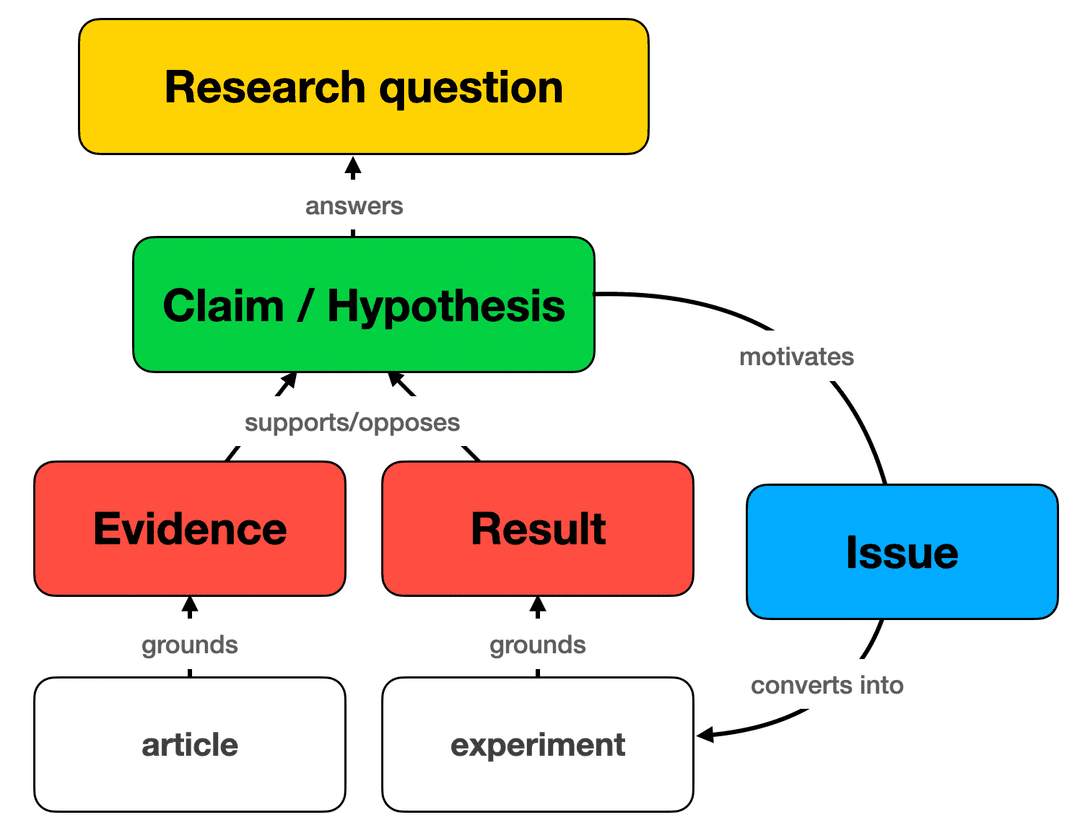
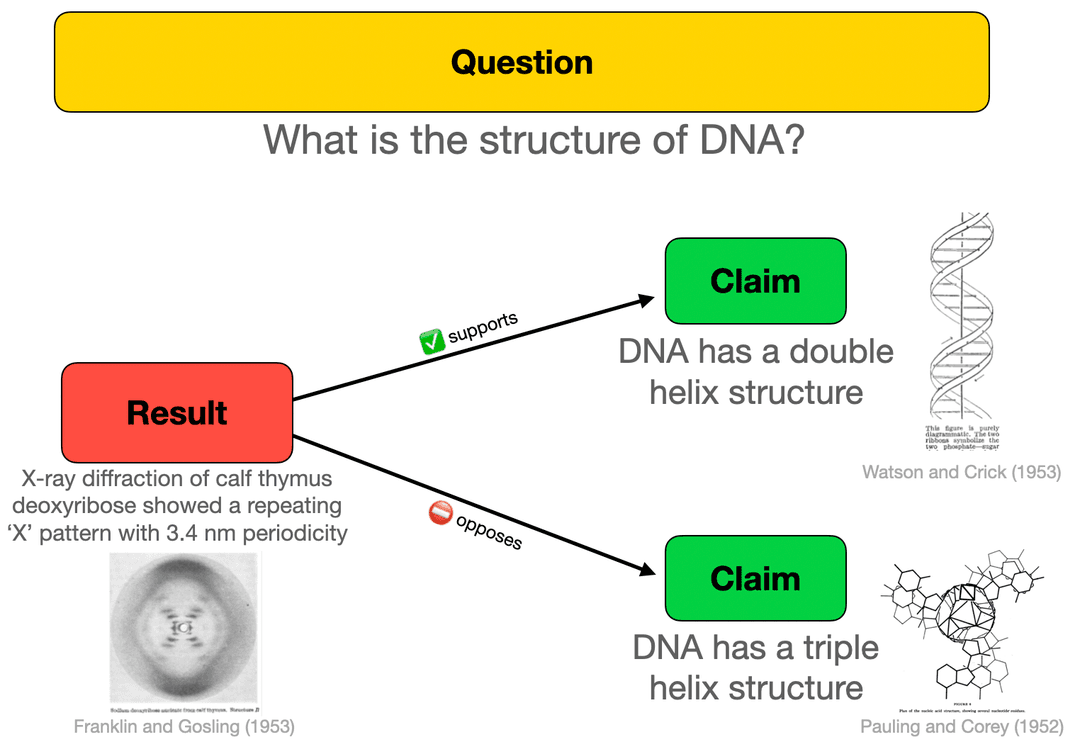
Figure 1:
(Left) An information model for modular research contributions — a discourse graph. Evidence (results) are discrete observations from a single experiment, dataset, or figure panel/table of a journal article. (Right) Distinguishing models of DNA structure with an experimental result by Rosalind Franklin. In an imagined modular research publishing environment, Franklin could post the result, and Crick/Watson would need to cite the result to support their claim that DNA forms a double helix.
License: CC-BY4.0
Indeed, our cell biology lab operates on this principle:
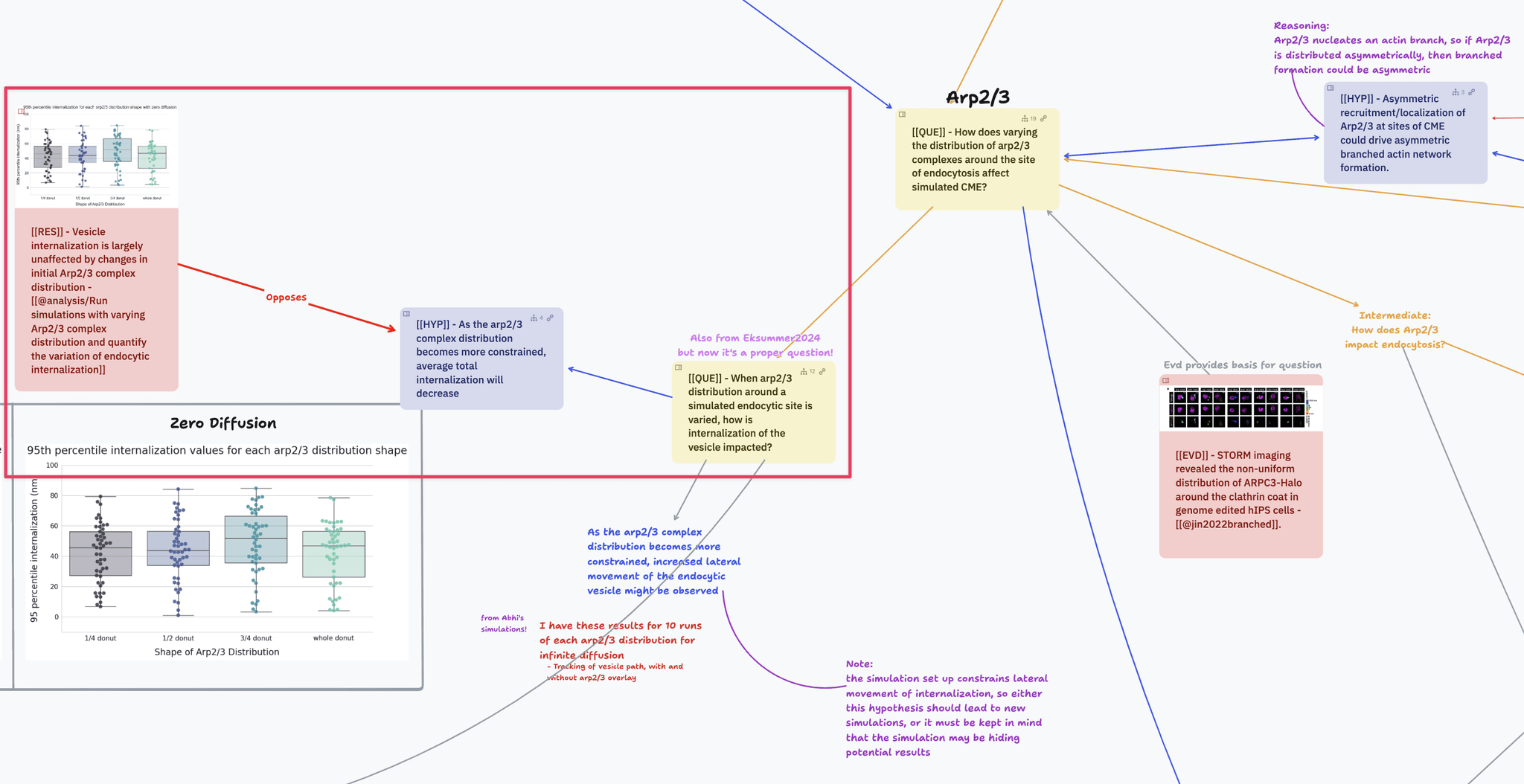
Figure 2:
A "discourse graph" by the MATSUlab. We compile these results into panels of figures for research articles, or share them individually to support our evolving models of cell biology.
License: CC-BY4.0
In an ongoing pilot supported by the Chan Zuckerberg Initiative and The Navigation Fund, we've introduced this approach to several other labs around North America, in the fields of cell biology, biochemistry, and quantum biology. Our early observations indicate that the process helps researchers think like a scientist, gain confidence in sharing early work, and make discrete contributions to shared research projects.
What is modular research attribution?
As these networks of research results and claims grow beyond a single lab, it will be increasingly important to share, track, and cite individual results between collaborating research labs and beyond.
We propose that attribution across modular research elements will unlock multi-lab collaboration, making it safer for researchers to contribute individual research results in a shared project earlier, confident that their work will make a substantive contribution and will be appropriately recognized.
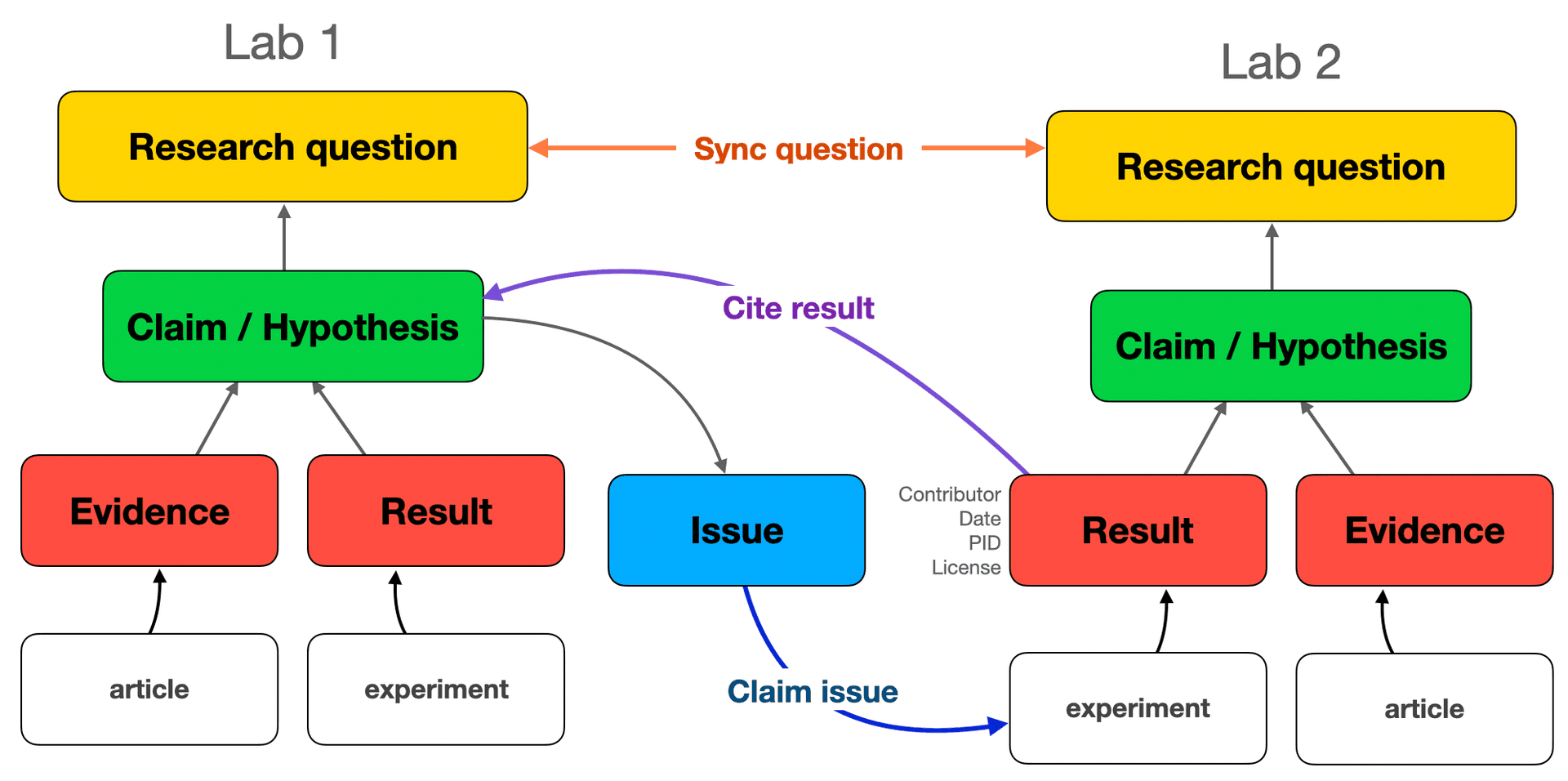
Figure 3:
Schema for sharing and citing discrete research objects such as hypotheses and claims between research labs.
License: CC-BY4.0
To enable a larger, more diffuse network of contributions, a few types of metadata are needed:
- Contributor (with an identifier like ORCID)
- Date (so that there is a transparent audit trail between research elements)
- Identifier (some unique value that gets you back to the posted material)
- License (eg a Creative Commons license that stipulates you must attribute the contributor for reuse)
What about AI?
Exactly! This system may be more compatible with AI than narrative articles on their own. By specifying the core elements of research arguments, we give Large Language Models scaffolding for properly using and citing the building blocks of knowledge. In turn, by properly citing our results, we can better track the utility and impact of our original research.
What is this workshop?
We are convening a 22-person workshop that consolidates emerging parallel efforts to build a proof-of-concept modular research attribution network, enabling researchers to share, discover, and attribute discrete research results.
Beyond a single "one size fits all" app or database, we seek to design, prototype, and test an interoperable network for researchers to share and reference granular results with collaborators outside their lab. We will bring together practicing scientists, designers, and engineers to share real-world scientific use cases, design accessible interfaces, and build proof-of-concept workflows from our user data.
Success looks like:
- Participating researchers share real-world, attributable examples of their research results with their labmates or collaborators, through different user-facing applications, thanks to the interoperable protocol that we develop
- The standards we develop are incorporated into the participating tool builders' applications, such as Discourse Graphs and Semble
- We collect evidence indicating how modular attribution may be a more accurate and useful signal for scientific contribution than journal article authorship alone
The aforementioned Continuous Science Foundation workshop led to a schema for interoperable manuscript composition, called OXA. We think it's a starting point for these interoperable modular research standards for attribution.


Figure 4:
Emerging standards and schemas for interoperable research manuscript composition.
License: CC-BY4.0
Apply if:
- You have a potential use case! "I am a researcher who wants to collaborate by…." "I have been sharing my results in a modular way…"
- You design human/computer interaction systems! "I've designed user experiences for…" "I have an idea for how researchers would interact with these applications…"
- You like to build interoperable systems for research communication and/or collaboration! "I created a means of connecting…" "I want to build data systems that…"
- You have a perspective on the emerging "scientific communication ecosystem" beyond journal articles! "I helped bring preprints to…" "I am bringing…"
- Or: you have another possible contribution not listed here!
Commitments
Prior to the meeting, we will meet in small groups by Zoom for a total commitment between 2 and 5 hours, in order to iterate on an initial standard/schema, use cases, and designs. Attendees will be required to join the entire in-person meeting.
Because we can only bring 22 people to the workshop, we will endeavor to have a Zoom workshop, before and after the in-person workshop, that incorporate and harness the ideas and enthusiasm of applicants who we could not invite in person.